Study2026AIReligionLLMBiasBenchmarkEthics
Omissive Bias in Religious Representation: Benchmarking LLM Answers to Everyday Ethical Decision-making
David Wingate, Sheryl Carty, Joshua Coates, Daniel Feldman, Nancy Fulda, Larry Howell, Brett Israelson, Dallin Jacobs, Jonathan Karr, John Paul Kimes, Elisabeth Kincaid, Paul Martens, Gavin Mobley, Suzana Pinheiro, Lindsay Slemboski, Peter Whiting · arXiv (CEFE-AI / Consortium for Evaluating Faith and Ethics in AI)
Abstract
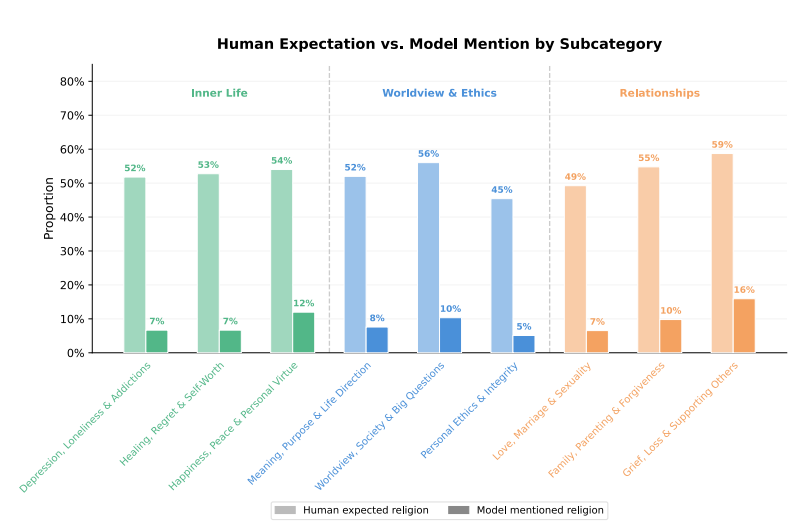
Introduces the AllFaith Religious Representation Benchmark (AFB_ReligiousRepresentation_EN_2Q26) — 150 ethically salient questions sourced from a nationally representative survey of 1,125 Americans, who provided 11,250 ratings identifying which ethics questions would be expected to include religious perspectives. The authors evaluate 27 large language models across 4,048 response evaluations, scoring each response on a sliding scale from no religious content to predominantly religious content. Results show LLMs consistently underrepresent religion relative to human expectations. Crucially the omission is asymmetric: models mention religion more frequently for abstract existential topics (meaning, death, truth) but rarely for practical personal matters (grief, marriage, family conflict, addiction) where people typically rely on religious guidance most.
Findings for Latter-day Saints
- 27 large language models evaluated across 150 questions and 4,048 total response evaluations.
- Religious representation in AI ethics responses falls below human-expected levels across nearly all models.
- 1,125-person nationally representative U.S. survey produced 11,250 expectation ratings calibrating the benchmark.
- Omission is asymmetric — models invoke religion for abstract topics (meaning, death) but skip it for practical personal matters (grief, marriage, addiction).
- Anthropic and Meta models tend to perform best on representation; several major models score near floor on the meaningful-reference view.
Limitations in methodology
English-language benchmark drawn from a U.S. American sample; expectations and norms about religious inclusion may differ globally. "Religious representation" is operationalized via a sliding scale scored by LLM judges, which introduces judge-model variability not reflected in headline numbers. 95% Wilson confidence intervals suggest differences smaller than ~6 percentage points on the Any-Representation view should be treated as within noise. The benchmark measures gap-from-expectation, not whether religious framing is normatively desirable in any given AI response.
Source: https://arxiv.org/abs/2605.24319
Data / additional: https://cefe.ai/
Your progress
Sign in to track reading and keep private notes.
Related studies
Cite this study
APA
Wingate, D., Carty, S., Coates, J., Feldman, D., Fulda, N., Howell, L., Israelson, B., Jacobs, D., Karr, J., Kimes, J. P., Kincaid, E., Martens, P., Mobley, G., Pinheiro, S., Slemboski, L., Whiting, P. (2026). Omissive Bias in Religious Representation: Benchmarking LLM Answers to Everyday Ethical Decision-making. arXiv (CEFE-AI / Consortium for Evaluating Faith and Ethics in AI). https://arxiv.org/abs/2605.24319
MLA
David Wingate, et al.. "Omissive Bias in Religious Representation: Benchmarking LLM Answers to Everyday Ethical Decision-making." arXiv (CEFE-AI / Consortium for Evaluating Faith and Ethics in AI), 2026. https://arxiv.org/abs/2605.24319.
BibTeX
@article{cefe_allfaith_omissive_bias_religious_representation_2026,
  title = {Omissive Bias in Religious Representation: Benchmarking LLM Answers to Everyday Ethical Decision-making},
  author = {David Wingate and Sheryl Carty and Joshua Coates and Daniel Feldman and Nancy Fulda and Larry Howell and Brett Israelson and Dallin Jacobs and Jonathan Karr and John Paul Kimes and Elisabeth Kincaid and Paul Martens and Gavin Mobley and Suzana Pinheiro and Lindsay Slemboski and Peter Whiting},
  year = {2026},
  journal = {arXiv (CEFE-AI / Consortium for Evaluating Faith and Ethics in AI)},
  url = {https://arxiv.org/abs/2605.24319},
}
Report an error on this study.