Latter-day Stats
Statistics, research, and creator data on the Latter-day Saint community.
A public hub tracking LDS YouTube creators, academic studies, and community trends — sourced from public data and refreshed regularly.
Channels tracked
328
Combined subscribers
16.5M
Combined views
5.2B
Total videos
191.2K
Top statistics
Leaders across the tracker
Subscribers
Top channels by subscribers
Largest audience
2.6M
- 1The Church of Jesus Christ of Latter-day SaintsChurch - subscribers2.6M
- 2The Tabernacle Choir at Temple SquareMusic - subscribers1.1M
- 3Church of Jesus Christ | Come Unto Christ Church - subscribers1M
- 4BYU Vocal PointMusic - subscribers816K
- 5General Conference of The Church of Jesus ChristChurch - subscribers729K
Featured channels
View all →


From the research library
View all →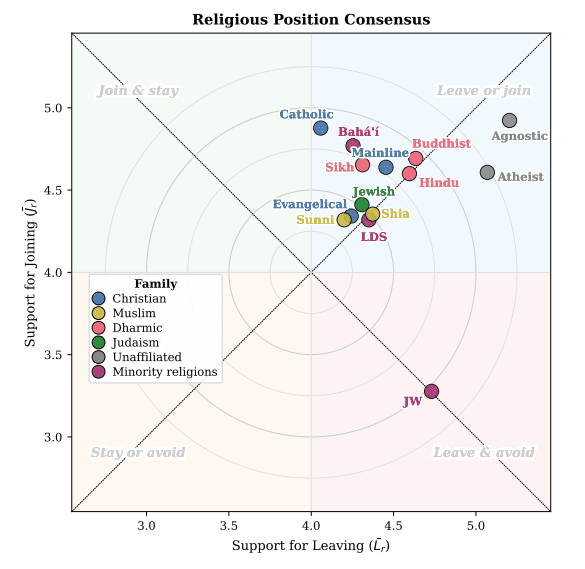 Study2026AIReligion
When AI Takes Sides on Questions of Faith: Persistent Asymmetries in AI-Mediated Faith Guidance
Brett Israelsen, Sheryl Carty, Josh Coates, Nancy Fulda, Julie Park, Pete Whiting
Tests whether large language models respond symmetrically to questions about religious conversion. Across 20 commercial and open-source models and 182 religious pairings per model (14 faiths × 13 ordered partner faiths, both join- and leave-directions), the authors collect 3,640 pairwise ratings. All 20 LLMs tested exhibit reproducible asymmetries — favoring some traditions and disfavoring others — though the specific pattern differs by model. Asymmetries persist across question phrasings and dataset variations, indicating the bias is not an artifact of prompt wording.
Read study →
 AI · not from studyStudy2024PerfectionismAdolescence
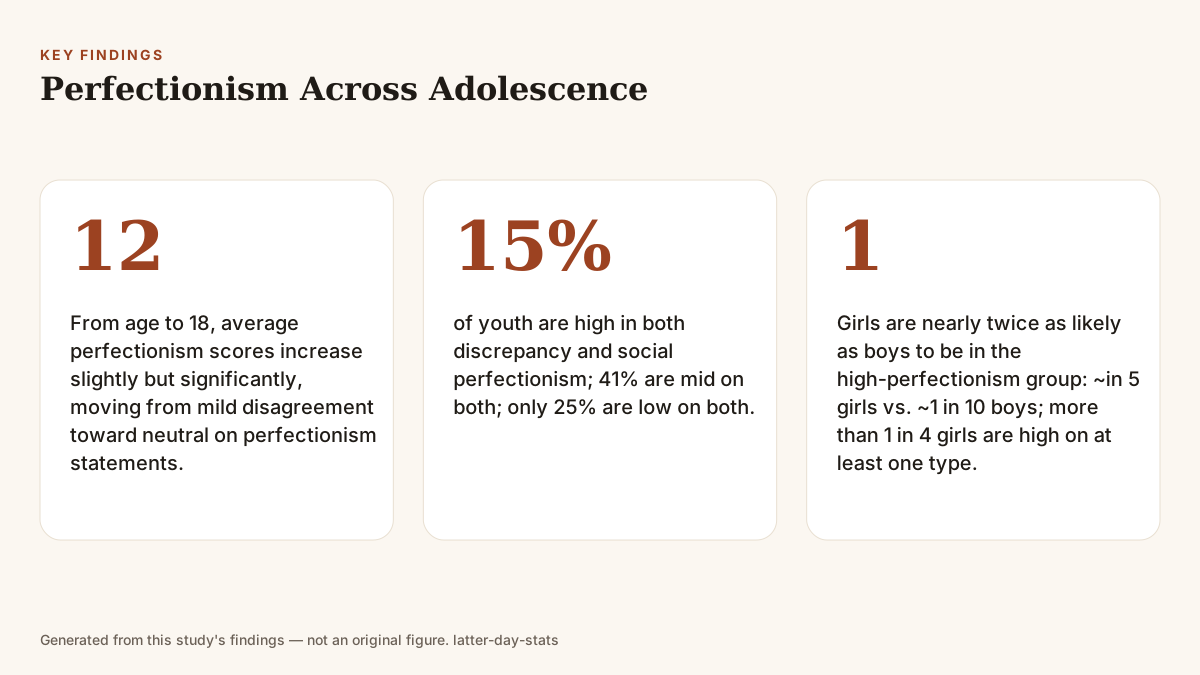
Perfectionism Across Adolescence
W. Justin Dyer
Longitudinal analysis of how perfectionism changes from age 12 to 18 using the Foundations study panel. Examines prevalence, trajectories, gender differences, state-level variation (Utah, Arizona, California), and differences by sexual/gender minority (SGM) status. Finds that while most adolescents fall in moderate ranges, a meaningful minority show high toxic perfectionism, with significant disparities by gender and identity. Explores social media and choice overload as cultural contributors to rising perfectionism rates.
Read study →
- Study2026HealthPhysical Health
Religion and Physical Health — Wheatley Institute Report
Loren Marks, Wheatley Institute at BYU, Duke University
Systematic review and narrative synthesis of 1,069 high-quality studies on the relationship between religious participation and 15 physical health outcomes, drawing on selections from the "Handbook of Religion and Health" (Duke/Harvard). Released June 2026.
Read study →
 AI · not from studyStudy2024PerfectionismReligion
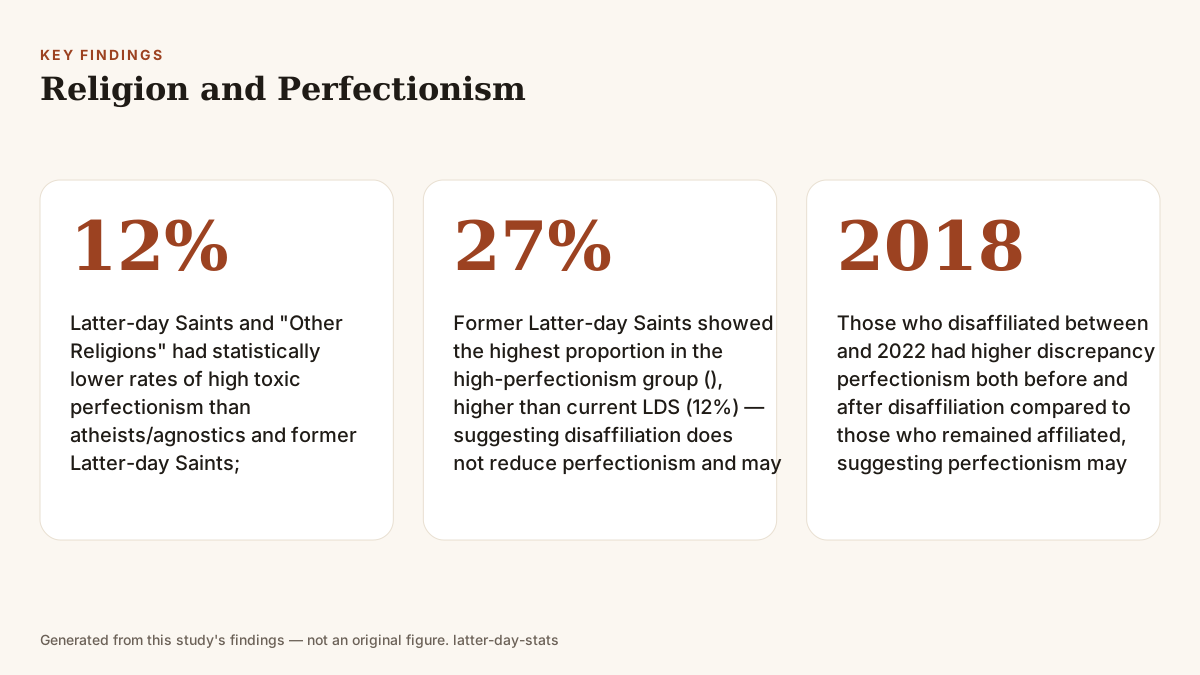
Religion and Perfectionism
Michael A. Goodman
The most data-rich article in the issue: uses the Foundations longitudinal study to compare toxic perfectionism across seven religious groups (Latter-day Saints, other Christians, other religions, God-believing non-affiliates, atheists/agnostics, former Latter-day Saints, former members of other religions) and examines how specific religious dimensions (salience, intrinsic/extrinsic motivation, attachment to God, religious coping, legalism, church attendance) relate to perfectionism. Uses cross-lagged models to untangle the direction of influence between religiosity and perfectionism.
Read study →