Study2024PerfectionismReligionLatter-day SaintsDisaffiliationLongitudinalMental Health
Religion and Perfectionism
Michael A. Goodman · BYU Studies Quarterly, 63(4)
 AI · not from study
Abstract
The most data-rich article in the issue: uses the Foundations longitudinal study to compare toxic perfectionism across seven religious groups (Latter-day Saints, other Christians, other religions, God-believing non-affiliates, atheists/agnostics, former Latter-day Saints, former members of other religions) and examines how specific religious dimensions (salience, intrinsic/extrinsic motivation, attachment to God, religious coping, legalism, church attendance) relate to perfectionism. Uses cross-lagged models to untangle the direction of influence between religiosity and perfectionism.
Findings for Latter-day Saints
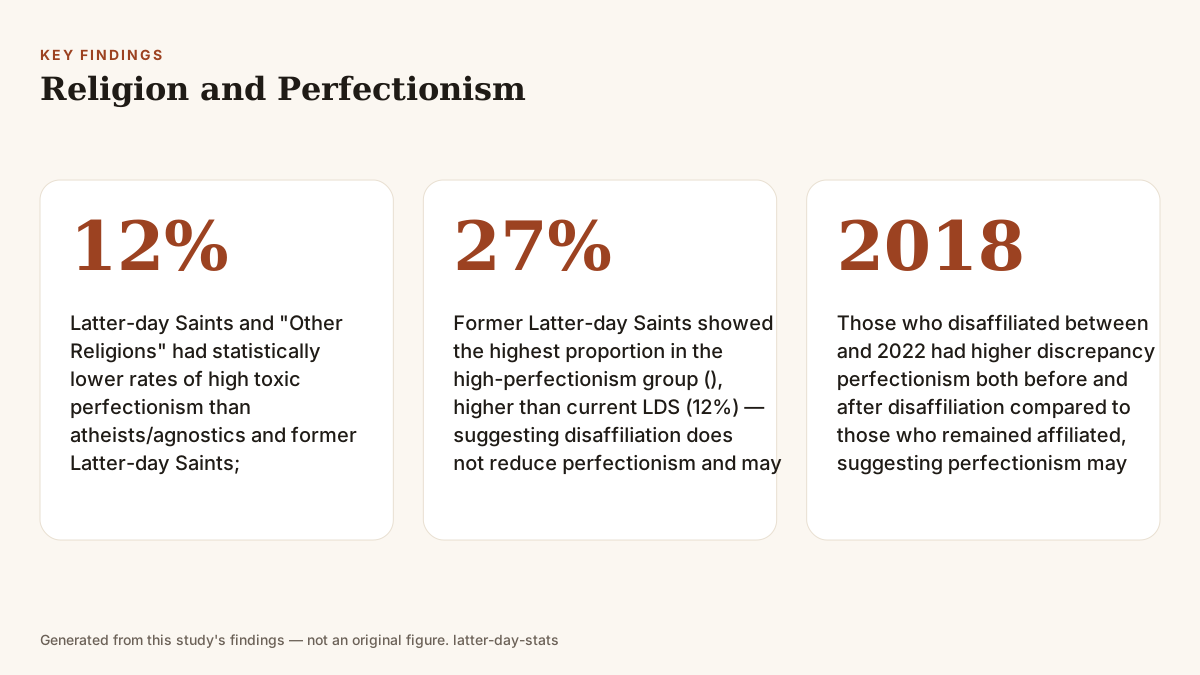
- Latter-day Saints and "Other Religions" had statistically lower rates of high toxic perfectionism than atheists/agnostics and former Latter-day Saints; high-perfectionism rates: LDS 12%, Other Christian 13%, Other Religion 11%, Atheist/Agnostic 20%, Former LDS 27%, Former Other Religion 24%.
- Former Latter-day Saints showed the highest proportion in the high-perfectionism group (27%), higher than current LDS (12%) — suggesting disaffiliation does not reduce perfectionism and may follow from it.
- Those who disaffiliated between 2018 and 2022 had higher discrepancy perfectionism both before and after disaffiliation compared to those who remained affiliated, suggesting perfectionism may predict disaffiliation rather than affiliation causing perfectionism.
- Intrinsic religious motivation (doing religion for its own sake) was associated with lower toxic perfectionism; extrinsic motivation (social approval) and introjected motivation (guilt/shame) were associated with higher toxic perfectionism.
- Higher religious salience (religion as central to one's life) was associated with lower toxic perfectionism, with the inverse relationship strongest for high levels of toxic perfectionism.
- Negative religious coping (feeling punished by God) showed the strongest relationship with toxic perfectionism of all religiosity dimensions examined; high-discrepancy-perfectionism youth had 66% in the high-introjected-motivation group vs. 27% of low-perfectionism youth.
Limitations in methodology
Sample from Utah, Arizona, and California; smaller non-LDS religious subgroups limit statistical power for fine-grained comparisons across all groups. Cross-lagged models strengthen causal inference but cannot fully rule out confounding. Religiosity measures are self-reported. Longitudinal attrition may affect representation of those who disaffiliate.
Source: https://byustudies.byu.edu/issue/63-4
Your progress
Sign in to track reading and keep private notes.
Related studies
Cite this study
APA
Goodman, M. A. (2024). Religion and Perfectionism. BYU Studies Quarterly, 63(4). https://byustudies.byu.edu/issue/63-4
MLA
Michael A. Goodman. "Religion and Perfectionism." BYU Studies Quarterly, 63(4), 2024. https://byustudies.byu.edu/issue/63-4.
BibTeX
@article{byu_studies_63_4_religion_and_perfectionism,
  title = {Religion and Perfectionism},
  author = {Michael A. Goodman},
  year = {2024},
  journal = {BYU Studies Quarterly, 63(4)},
  url = {https://byustudies.byu.edu/issue/63-4},
}
Report an error on this study.