Study2024PerfectionismMental HealthSuicideDepressionAdolescenceLatter-day Saints
Perfectionism's Influence on Adolescent Mental Health
Mark D. Ogletree · BYU Studies Quarterly, 63(4)
 AI · not from study
Abstract
Examines the relationship between toxic perfectionism and six adolescent mental-health outcomes — anxiety, depression, self-worth, suicidal ideation, video-game addiction, and pornography use — using Foundations longitudinal data. Uses cross-lagged models to assess whether perfectionism precedes or follows these outcomes. Finds perfectionism is a significant predictor of later suicidal ideation across multiple age points, with self-worth as the strongest correlate. Situates findings within Latter-day Saint theological context, arguing that a grace-centered understanding of the gospel reduces toxic perfectionism.
Findings for Latter-day Saints
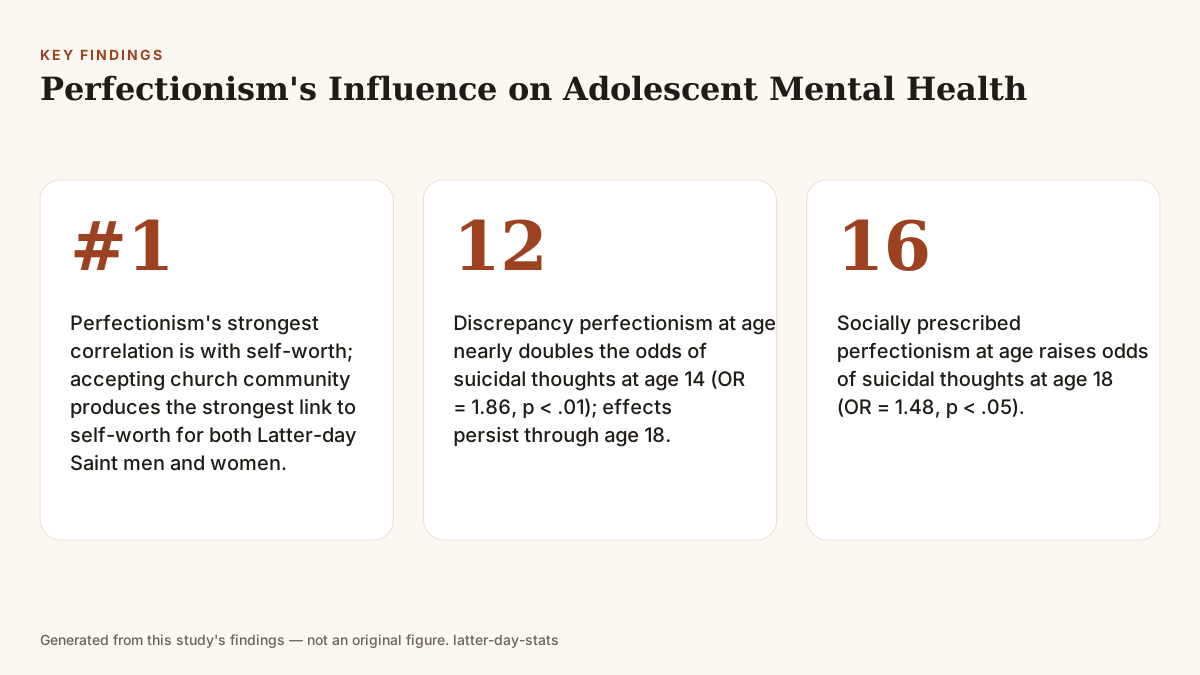
- Perfectionism's strongest correlation is with self-worth; accepting church community produces the strongest link to self-worth for both Latter-day Saint men and women.
- Discrepancy perfectionism at age 12 nearly doubles the odds of suicidal thoughts at age 14 (OR = 1.86, p < .01); effects persist through age 18.
- Socially prescribed perfectionism at age 16 raises odds of suicidal thoughts at age 18 (OR = 1.48, p < .05).
- Major depressive episodes among adolescent females rose from 13.1% (2004) to 28% (2022); among males from 5% to 11.5% over the same period (national data).
- Utah experienced a 136% increase in suicides among youth ages 10–17 from 2011 to 2015; suicide is now the second leading cause of death nationally for adolescents and young adults since 2017.
- All mental-health outcomes examined (anxiety, depression, self-worth, suicidal ideation, video-game addiction, pornography use) are significantly correlated with both discrepancy and socially prescribed perfectionism.
Limitations in methodology
Sample from Utah, Arizona, and California; Utah suicide trends reflect a geographic population with heavy Latter-day Saint concentration but should not be attributed solely to Latter-day Saint youth. Pornography and video-game measures are self-reported. Some depression and suicide statistics cited from national datasets (not the Foundations sample itself). Causal claims are supported by cross-lagged longitudinal models but cannot be fully established from observational data.
Source: https://byustudies.byu.edu/issue/63-4
Your progress
Sign in to track reading and keep private notes.
Related studies
Cite this study
APA
Ogletree, M. D. (2024). Perfectionism's Influence on Adolescent Mental Health. BYU Studies Quarterly, 63(4). https://byustudies.byu.edu/issue/63-4
MLA
Mark D. Ogletree. "Perfectionism's Influence on Adolescent Mental Health." BYU Studies Quarterly, 63(4), 2024. https://byustudies.byu.edu/issue/63-4.
BibTeX
@article{byu_studies_63_4_perfectionism_adolescent_mental_health,
  title = {Perfectionism's Influence on Adolescent Mental Health},
  author = {Mark D. Ogletree},
  year = {2024},
  journal = {BYU Studies Quarterly, 63(4)},
  url = {https://byustudies.byu.edu/issue/63-4},
}
Report an error on this study.