Study2024PerfectionismParentingFamilyAdolescenceLongitudinal
Parental Influence on Adolescent Perfectionism
Jenet Erickson, Olivia Forsberg, McKenna Schmidt · BYU Studies Quarterly, 63(4)
 AI · not from study
Abstract
Empirical analysis from the Foundations longitudinal study examining how parents transmit toxic perfectionism to their children through three pathways: (1) behavioral modeling of perfectionism, (2) psychological control (withholding love unless standards are met), and (3) unhealthy family cohesion and flexibility patterns. Finds meaningful gender differences in how maternal vs. paternal modeling and psychological control affect sons vs. daughters. Identifies authoritative parenting — combining structure with warmth — as protective against toxic perfectionism.
Findings for Latter-day Saints
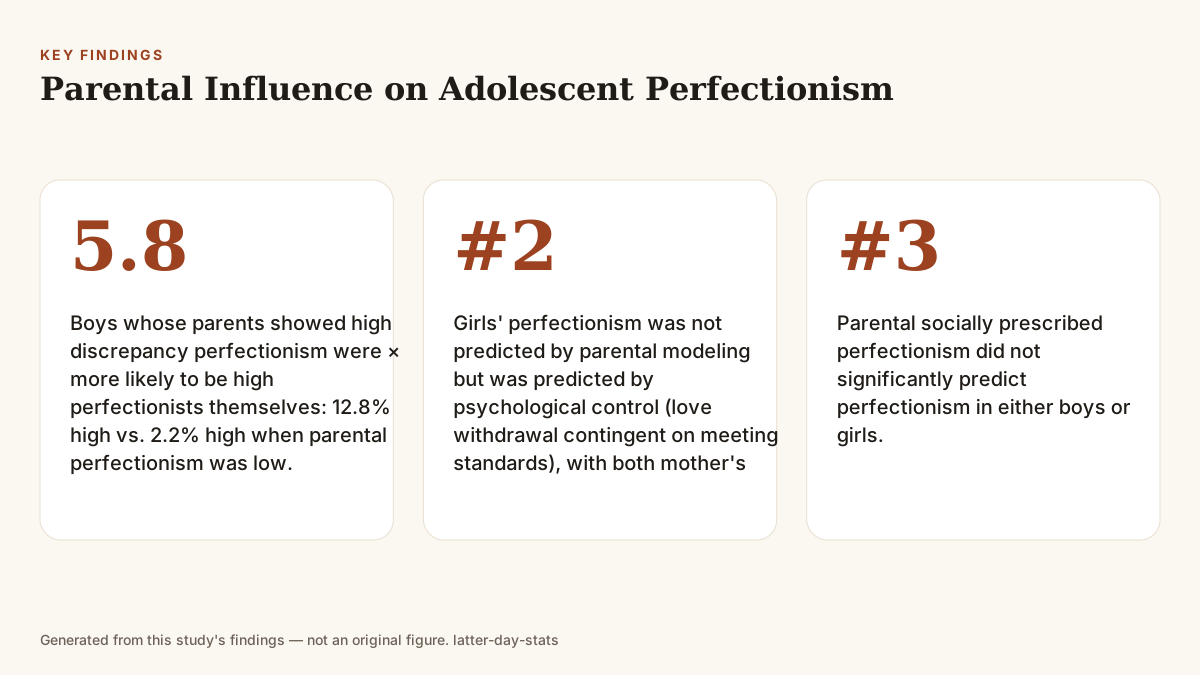
- Boys whose parents showed high discrepancy perfectionism were 5.8× more likely to be high perfectionists themselves: 12.8% high vs. 2.2% high when parental perfectionism was low.
- Girls' perfectionism was not predicted by parental modeling but was predicted by psychological control (love withdrawal contingent on meeting standards), with both mother's and father's psychological control playing a role.
- Parental socially prescribed perfectionism did not significantly predict perfectionism in either boys or girls.
- Enmeshed or rigid family structures (extreme cohesion or inflexibility) predicted higher youth perfectionism, while authoritarian or permissive parenting alone — without psychological control — did not.
- Authoritative parenting (demanding but warm, structured but flexible) was associated with lower rates of toxic perfectionism in adolescents.
Limitations in methodology
Sample limited to Utah, Arizona, and California. Parenting measures are based on child and parent self-report, subject to recall and social-desirability bias. The study cannot establish causation between parenting style and child outcomes with certainty, though longitudinal design strengthens inference. Sample is primarily Latter-day Saint and comparison-group, limiting generalizability to other populations.
Source: https://byustudies.byu.edu/issue/63-4
Your progress
Sign in to track reading and keep private notes.
Related studies
Cite this study
APA
Erickson, J., Forsberg, O., Schmidt, M. (2024). Parental Influence on Adolescent Perfectionism. BYU Studies Quarterly, 63(4). https://byustudies.byu.edu/issue/63-4
MLA
Jenet Erickson, et al.. "Parental Influence on Adolescent Perfectionism." BYU Studies Quarterly, 63(4), 2024. https://byustudies.byu.edu/issue/63-4.
BibTeX
@article{byu_studies_63_4_parental_influence_perfectionism,
  title = {Parental Influence on Adolescent Perfectionism},
  author = {Jenet Erickson and Olivia Forsberg and McKenna Schmidt},
  year = {2024},
  journal = {BYU Studies Quarterly, 63(4)},
  url = {https://byustudies.byu.edu/issue/63-4},
}
Report an error on this study.